
What You Need To Know About Comedy Timing
Training Module Seven: Intro And Lesson Links | Members Area
Begin
Introduction
 If you have structured your stand-up comedy material using the guidelines provided in this course and you have taken it through the professional rehearsal process…
That means you have most of the timing elements you need for the stage already covered.
Let me be more specific. Stand-up comedy timing is comprised of 5 elements, much of which is based on how you naturally speak:
- Consistent Line Length
- Line Rhythm
- Consistent Punchline Frequency
- Delivery Speed
- Pause Management
I’m going to cover the first three elements above very briefly — like I said, these elements are already built into the process that I showed you to structure and rehearse your stand-up comedy material.
Then, I will focus on the last two elements — delivery speed and pause management.
Let’s get started…
Part 2
Line Rhythm And Punchline Frequency
At this point you should already know:
- What the length of a spoken word line is as it relates to how you speak naturally
- You have your own speaking rhythm, based on the breath pauses and other natural speaking pauses that you take when speaking to others
- Punchlines are your sense of humor reactions that need to occur 4-6+ times per minute in your stand-up comedy material
- Headliner stand-up comedy material demands an economy of words, enhanced by incorporating body language, facial expressions, voice inflection and tone variations, etc.
Here are a couple more things you need to be aware of as it relates to comedy timing:
Line Rhythm Adjustments
There may be lines in your stand-up comedy material where you may need to add a word or two and here’s why…
Because you do have your own natural speaking rhythm, there may be lines in your stand-up comedy material that don’t exactly reflect that rhythm.
Don’t be afraid to add a word or two to lines as needed if you find them awkward to say or you find yourself stumbling over words in a line.
Still, you want to strive to say and express your stand-up comedy material in the fewest words possible and in a way that is most natural to you and your normal speaking rhythm.
Consistent Punchline Frequency
This one is easy. Consistent punchline frequency is nothing more than having a consistent number of punchlines (and tag lines) per performing minute.
How do you develop this consistency?
Using the three-line rule. It’s just a matter of common sense.
Here’s the big deal:
If the overall number of set-up lines is consistently more than 3-5 lines before you get to a punchline, it becomes an impossibility to get 4-6 laughs per minute on stage.
It is much easier to “get on a roll” or establish and maintain momentum in your act if you have consistently frequent punchlines.
Even though you may not always have the same number of set-up lines before a punchline (it may be 1, 2, or 3 – possibly more on occasion), using the 3 line rule as your guide, the punchlines come frequently enough to establish a rhythm that you and your audience will be able to feel.
This rhythm can be so powerful that it may actually cause your audience to laugh during set-ups lines. Why?
Because you’ve conditioned them to expect to laugh at a given consistent interval, the audience will automatically respond with laughter at each such interval while you are performing.
Needless to say, consistent punchline frequency is an important part of timing.
One final note:
These three timing elements — constant line length, line rhythm and consistent punchline frequency can be worked on and honed off the stage.
Delivery speed is also something that can (and should) be honed off the stage in your professional rehearsal sessions, but there is much more to know about which I will cover next.
Then I will discuss pause management, which is audience dependent.
Part 3
Delivery Speed
Delivery speed is nothing more than the natural speed at which you talk. Each of us talks at a slightly different rate — some people talk faster, some people talk slower.
Don’t get me wrong — there are times each of us speaks faster or slower depending on the situation and what we are talking about.
But overall, each of us has our own “normal” speed at which we communicate with others verbally.
As you rehearsing your stand-up comedy material, I want you to keep this in mind:
It is very important that you capture the “normal” speed at which you are used to talking and communicating verbally.
If you are unaccustomed to the stage, you may find yourself rushing to get to the punchlines and talking too fast.
If you are rushing your material, the audience will not only sense it, but they will be more reluctant to respond the way you desire.
You will lose any air of confidence you have by trying to “push” your material toward punchlines and talking faster than you are accustomed to.
Talking at your normal rate of speed will display to an audience that you are in no hurry with what you have to say.
It will give you an air of confidence, even if you are not feeling so confident on stage at the time.
I have talked about the goal of getting 4-6+ laughs per minute on stage.
Getting that quantity of laughter should not be a result of talking quickly. It should be the result of having frequent punchlines that are delivered at your “normal” talking speed.
Having frequent punchlines should be the result of:
- Capturing your own true individual sense of humor
- Using the three-line rule to ensure your punchlines occur at an acceptable frequency
Let me just say that you will get more laughs from so-so material that is delivered at your overall natural, consistent speed than you will from rushing through really funny material.
If you are talking so fast that your audience can’t understand what you have to say, you might as well be performing for the deaf.
At the same time, you don’t want to talk too slowly or sound like a mechanical robot when you are delivering your material.
Ultimately, you want your material to sound as natural as possible while still providing needed breath pauses and other natural pauses that come with the way you normally speak so that an audience can grasp what you are saying.
Beyond these natural speaking pauses are more deliberate pauses that I will discuss shortly in the “pause management” section.
While timing is directly affected by the size of the audience you are performing for…
For the most part, audience size should have little overall impact on your delivery speed, no matter how large or small the audience is.
So, are there any practical steps you can take to capture your natural speed of delivery?
Yes — it’s called professional rehearsal.
The more you do that one simple thing, the more you’ll get used to delivering stand-up material at your natural speech rate — the speed at which you speak naturally.
Then, when you make the transition from your professional rehearsal sessions to the live stage, you should find it much easier to maintain that natural speed of delivery.
Part 4
Pause Management
The final element in the delivery of material related to timing is a factor I call “pause management.”
Pause management is basically the control over the length of time you pause in any given part of a bit.
Pauses are usually referred to in beats (seconds) and are generally used to do three things:
- Create more time between set-up lines (and extension of natural pauses)
- Give more impact to key words and punchlines
- Let audiences absorb punchlines
I’ll talk about each of these now…
Creating Time Between Set-Up Lines (Natural Pauses)
The first function of pausing is to create a small space of time between set-up lines if needed. This gives the audience that small fraction of time they need to understand what you are saying to them.
These pauses also give you a chance to breathe while you are delivering material.
These are the natural pauses I have already discussed. They help you determine your set-up line length in the format I discussed and therefore capture your natural speaking rhythm.
Depending on your delivery speed, you may find that you will need to pause just a bit longer for larger audiences. Why?
It has been my experience that the more people in a room together, the longer it takes (collectively) for that group to comprehend what you have to say.
So how does this affect your natural pauses?
You may have to pause slightly longer at your natural breaks when performing for big audiences. How you gauge this is through experience.
The key point here is to understand that you don’t “fabricate” extra pauses just because the audience is larger. You still want to capture the natural pauses that you have when you talk.
Giving More Impact to Key Words and Punchlines
Another part of pause management is enhancing the impact of your key words and punchlines.
This is done to cause more of an unexpected response from a key word or punchline.
It gives the audience time to make a logical assumption about what you are going to say before you say something completely different and unexpected.
Using pauses to give more impact to key words is something you have to feel on the inside. The human mind works very quickly.
If you pause too long, the audience might have enough time to figure out what you are going to say. If you don’t pause long enough, you may lose the impact you could have had with a longer pause.
I don’t always pause before a key word or keyword phrase. When I do, as a general rule, I use at least two seconds for pauses before key words.
I identify those on paper with periods where the pause should be. Each period represents one beat. So two periods.. is two seconds (or beats).
Here’s an example from one of my own stand-up comedy bits:
S: I went out and played my first game of golf today
S: I don’t know anything about golf and I still don’t
S: So I went out there and I shot a 97
S: Everybody’s goin’ “It’s not that bad, it’s not that bad”
P: Then we went to the.. second hole
T: I was already starting to get tired
Note that it is the pause before the words “second hole” that gives the punchline more impact. I included that pause on purpose to give the keys words the impact I wanted them to have.
Once again, this is the beginning of a several-minute bit on golfing — and, as I have mentioned before, the beginning of my bits have a tendency to have a few more set-up lines (but they are short).
But no matter how many set-up lines I use, my goal is always to keep them short and make sure they capture the natural rhythm of the way I talk.
Here’s the last aspect of pause management…
Part 5
Letting Audiences Absorb And Respond To Punchlines
The last reason to use more deliberate pause management is to give your audience time to absorb the punchline and start laughing.
Not only that, but you also want to give your audience time to laugh completely at your punchline.
Pauses at the end of punchlines are a bit easier to manage. As a general rule, I usually pause up to three seconds after a punchline. If there are no laughs by the third second of that pause, then I just continue on with my material without altering my delivery speed.
I don’t speed up because the audience didn’t laugh.
Giving the audience time to laugh after a punchline and maintaining a consistent delivery speed (no matter what happens) will give you an air of confidence even if you don’t feel so confident at the time.
Here’s an important point I need to make now:
Don’t be afraid of silence during your set-up lines. Silence means the audience is listening to what you have to say.
If you deliver a punchline and there is silence, obviously you have more work to do on that part of your act — but not at that very moment.
Don’t get spooked and crank up your delivery speed and omit pauses after punchlines because of silence.
Doing that may eliminate laughs you could have gotten from the rest of your act.
Waiting for those seconds at the end of a punchline can seem like an eternity when you first start doing stage work.
In one of the Indiana Jones movies, Harrison Ford finds himself before a very deep ravine with no obvious way across it.
Then he figures out that he must step out into the ravine to cross it. He hesitates. He takes the step and lands on a hidden bridge that blends in so well with the view of the ravine that it couldn’t be seen.
You take the same step when you wait for the punchline to work once it has been delivered. But it is a most important step.
Waiting three seconds instead of two can make the difference between some giggles and causing an entire audience to bust up with long and loud laughter.
This is especially true if it takes an audience time to “get” the funny material you are delivering (when material really catches them off guard or requires a bit more thought).
Laughter is contagious, just like yawning. Once it starts you don’t want to stop it.
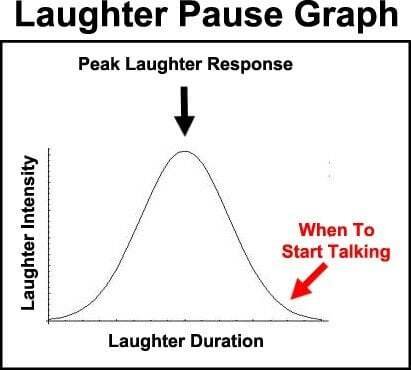
So if a punchline kills, don’t say anything until the laughs have almost gone away.
If you start talking too soon, you will snap the people out of the laugh because they won’t want to miss what you have to say next, or even worse, you’ll cut them off before they even get a chance to laugh.
This is called “running over the laughs.”
By running over laughs, you once again screw yourself out of the very laughter you worked so hard to get in the first place.
When I’m performing, I don’t want the laughter to fade to complete silence before I start the next bit. By starting the next bit when the laughs are almost gone helps me continue the rhythm and momentum I want.
It also eliminates potentially long and awkward gaps between a punchline and the next set-up line.
Here’s a graph to illustrate when you should start talking again once an audience has started laughing:
If you are performing for a large group and your punchlines are really working, you may have to wait five, six, or even more seconds before you can keep going due to the length of laughter.
Not that this is a problem; it’s exactly what you want.
But you will also want to keep in mind that the harder and longer the laughs are, the more time it takes up in relation to delivery of your act.
If you are prepared to deliver 5 minutes of material, you may only get through 4 minutes of it (on paper) before your 5 minutes (on stage) are up depending upon the size of the audience and the laughter response that you get from your stand-up comedy material.
Wrap Up
Wrap Up
As you can see, you have the ability to work on and hone 4 of the 5 elements that make up comedy timing — the same comedy timing that you use offstage.
The only element you must hone on the stage is pause management and that is because it is dependent upon an audience and your stage experience.
Let me wrap this lesson up with an important observation over the last several decades that I have made when it comes comedy timing:
The single, most common factor that keeps comedians who are getting laughs with their stand-up comedy material from generating headline level laughter is running over laughs.
In other words…
The don’t allow audiences time to fully laugh at their stand-up material.
Keep this in mind:
Audiences can’t laugh and listen to what you have to say at the same time.
If you are generating laughs but start talking before the audience has fully appreciated what you have to say with their laughter…
They will immediately stop laughing so they don’t miss what you have to say next.
If you want to see a real life example of what I am referring to when it comes to “running over laughs” and the impact it can have on the laughter response you can get from your stand-up comedy material…
Just take a look at the before and after videos of Killer Stand-up comedian Clayburn Cox.
Training Module Seven: Intro And Lesson Links | Members Area