
Getting Your Stand-up Comedy Material Ready For Live Audiences: Phase 2
Training Module Six: Intro And Lesson Links | Members Area
Begin
Introduction
 If you really want to stand head and shoulders above the vast majority of comedians vying for time on the stand-up comedy stage…
Pay close attention to the information in this lesson, which applies to both new and more experienced comedians alike.
Since stage time is a precious commodity that tends to be scarce in the beginning of one’s comedy adventures, it would seem that maximum preparation before any performance would be a no brainer.
But one of the primary reasons it takes many comedians years to make in real headway in stand-up comedy is because the only time they “rehearse” professionally is in front of an audience.
At this point, you should have your stand-up comedy material “fleshed out” from the initial rehearsal phase.
In other words…
You should know exactly what you are going to say to an audience and exactly how you are going to say it.
The next step is to prepare properly to deliver that material in a way that fits you like a glove, is genuine and appears as if you are spontaneously speaking from the “top of your head”.
The way you do that is during the professional rehearsal phase.
Before you move to the next section, you should read this special report:
Special Report: The Rehearsal Secret Every Comedian Should Know
Part 2
What You Need To Know About Professional Rehearsal
You should NEVER consider professional rehearsal a chore, but rather a critical component of making rapid progress as a comedy entertainer for a number of reasons:
1. For new comedians, to make sure that holding the microphone close to your mouth happens in a very natural way.
2. To ensure that your comedy material flows naturally and effortlessly with an economy of words, realizing that most of your laughter power will come from your delivery — not the words you say alone.
3. To make sure that your body language, facial expressions, and voice tone changes are not just natural, but in alignment with what you are saying and expressing to an audience.
4. To boost your confidence and stage presence (the posture that you use for professional rehearsal directly affects this and is covered in this lesson).
5. To help you develop develop momentum quickly with the best possible laughter frequency.
6. To make sure that your comedy material delivery reflects your natural rate of speech, rhythm and timing.
7. To eliminate the needs for notes or other memory crutches which limit your audience control and your laughter generation capabilities.
8. To stand out among the other comedians who are unable or unwilling to engage in professional rehearsal.
Fortunately for you, most comedians completely ignore the value of professional rehearsal. And I guess now is as good of time as many to tell you this…
If you walk on stage prepared like a pro and slay the audience — especially if you are new to stand-up comedy — you are going to severely tick off a number of comedians who have struggled for many months or even years, and still can’t seem to “figure it out”.
As of this moment, that’s their problem, certainly not yours. 🙂
So before I get to the process of professional rehearsal, I need to give you some secrets that you need to include in your professional rehearsal.
Part 3
Posture Matters Greatly When Your Rehearse Professionally
Most people are completely unaware that the posture you use when you engage in professional rehearsal can greatly impact your results on stage.
Let me explain this as simply as possible…
Your posture (which is an aspect of body language) is directly connected to your mental state.
For example…
If you are depressed or down trodden, your mind knows that your posture reflects that mood and is one that consists of:
- Lowered head
- Limited eye contact
- Slumped forward shoulders
This is the posture of depression or despair.
Your mind also knows that when you are your most confident and upbeat that your posture also reflects that mood and consists of:
- Head up
- Eyes forward and making contact
- Shoulders back (which automatically extends the chest outward)
This is the posture of confidence.
Here’s what you must understand:
Your posture is DIRECTLY connected to your mood, attitude and confidence level, just like your fingers are connected to your hand.
If you conduct your professional rehearsal sessions in the posture of depression, it will greatly reduce your confidence, eye contact, and increase anxiety when you are delivering your stand-up comedy material for an audience.
If you conduct your professional rehearsal sessions in the posture of confidence, it will train you to be more confident, make more eye contact, be in more control of the audience and reduce your anxiety when you are delivering your stand-up comedy material for an audience.
IMPORTANT: This is not a small issue and you should ALWAYS rehearse your stand-up comedy material in the posture of confidence for the best and fastest results.
Part 4
Eye Contact: A Major Audience Control Factor
One of the most important factors for controlling an audience (besides laughter generation) and giving the audience the appearance that you are confident and professional is continuous eye contact with the audience.
However, you are going to find on many stages that because of the stage lighting, you won’t be able to see most of the audience beyond the first several rows seated most closely to the stage.
Beyond that, you will be looking into darkness. So, how do you maintain eye contact with an audience that you can’t even see?
It’s easy actually if you understand that you only need to look in the direction of a group of audience members for each of those audience members think you are looking at them personally.
From the stage, there are 5 basic eye contact points that will cover audiences in most venues and give the appearance that you are looking at the entire audience when you are expressing your comedy material on stage:
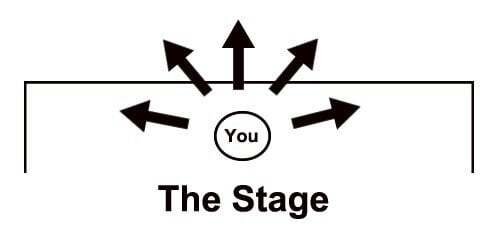
When you conduct your professional rehearsal sessions, you not only want to rehearse in the posture of confidence (head up, eyes forward, shoulders back naturally), but you also want to train yourself to keep constant eye contact with all the audience — not just the few audience members that you can see in the first couple of rows closest to the stage.
While there is no audience available for your private rehearsal sessions, let me remind you — on a well lit stage, you won’t be able to “see” most of your audience anyway.
But you always want to rehearse as if the room is full of people, keeping the 5 basic eye contact points in mind as you deliver and express your comedy material in a private setting.
Part 5
Harnessing The Power Of Spontaneity
You will notice that professional comedians are able to connect very quickly with audiences and laughter generation occurs quickly and effortlessly right from the beginning of their performances.
They give the appearance that they are simply pulling information right from the top of their head instead of simply “reciting” words that have been written on paper.
This is called spontaneity.
You can reproduce this same sort spontaneity in your professional rehearsal sessions and on the comedy stage if you can visualize what I am about to share with you.
Let’s say that you were in a spirited conversion with 5 of your friends. Each of your 5 friends is standing in one of the five eye contact points that was identified earlier in this lesson.
During the exchange of views, opinions, experiences, observations, etc. that occur during this dialogue, one of your friends says something that triggers your memory about something that is related.
The moment the opportunity presents itself and it’s your turn to talk, you immediately launch into your own story, experience, observation, opinion, etc…
“I was at the mall two weeks ago and…”
“Have you seen that TV commercial about…”
“I know that’s true because…”
You automatically assume that your friends will understand and relate to what you have to say about the topic being discussed.
You automatically look at each friend briefly as you are talking and sharing what you have to say.
And instinctively you know that you need to relay your story in the most condensed fashion (using your normal speech rate, timing and natural expressive traits) during your time to talk — before one of your friends jumps back into the conversation.
It is also at this point that you will be able to “get on a roll” and create frequent laughter with what you have to say during a conversation if what you have to say and express about the topic is funny and tightly presented, even though…
You may have told that same story or expressed those same observations, views, opinions, etc, dozens of times before with different people.
Well, guess what? If you fully understand that the mechanics of generating laughter are EXACTLY THE SAME in a conversation as they are when you are delivering stand-up comedy material on stage…
Then you should also understand that the only differences in the conversation scenario above and delivering stand-up comedy material are:
1. As soon as you get the microphone, it’s your turn to talk and express yourself. You don’t have to wait for a break between dialogue among others you are in a conversation with to get your turn to talk.
2. There are more people in the audience.
3. You are holding a microphone.
In other words…
Just like in a conversation with friends and you get your turn to talk:
You need to assume that those who are listening to what you have to say and express are your friends.
As a matter of fact, they are “guests” in your venue if you have adjusted your mindset accordingly.
You need to assume that your “guests” will understand and relate to what you are going to say and express — right from the very beginning of your act.
You need to realize that what you have to say and express in your own natural way needs to be tightly structured in order to “get on a roll” — with every topic, bit or chunk you have to offer.
Part 6
What You Need To Know Now About Performing Your Material For Live Audiences
Keep this in mind if you really want to slay an audience when you step on the stage…
You aren’t giving a speech as a comedian. You aren’t simply serving up “jokes” the way most comedians do in mechanical and largely ineffective way.
You are in the middle of a conversation and it is now your turn to talk — to express yourself in a way that is NO different than when you are in a spirited discussion with friends.
And just like in a conversation when a bunch of superfluous or non-essential information (filler) that only adds more time before the punchline…
Someone else may feel the need to speak up (which is what you DON’T want when you are delivering your stand-up comedy material).
Professional rehearsal is the key to recreating that exact same seemingly natural spontaneity that you display when it’s your turn to talk in a casual conversation.
Most comedians — even those who are well prepared — don’t have a chance of delivering headliner level comedy material because:
They assume that the audience won’t “get” or understand what they are talking about and feel compelled to provide additional “background” information about the subject, topic bit or chunk they are delivering.
And the minute they do that…
They have eliminated the possibility of getting 4-6+ laughs per minute and generating an average of 18+ seconds of laughter for each minute they are on stage.
So besides understanding that you are in the middle of a conversation and it’s simply your turn to talk with friends or “guests” who will “get” and understand what you have to say, know this:
1. After you have the microphone in hand and have said “thank you” for the obligatory applause that happens when you are introduced on stage…
It is now your turn to talk. Your audience already knows something about your part of the conversation and is ready to listen.
Don’t feel compelled to provide non-essential information to those you are communicating with.
2. The only transition you need from one topic, subject, bit or topic during your “talk time” is audience laughter.
In other words…
At no point in your stand-up comedy material do you need to provide “extra” information so the audience will “get” what you are going to talk about next.
When you are standing before an audience, you are STILL in the middle of a conversation and it is STILL your turn to talk.
And if your stand-up comedy material is developed using the techniques provided in this course and rehearsed professionally…
You should have no problem generating headliner level comedy material in short order once you have some stage time under your belt and begin to realize that…
Stand-up comedy is NOT nearly as difficult as it is made out to be if you have talent, you are well prepared and you actually know what you are doing on stage.
Now let’s cover the professional rehearsal process…
Wrap Up
Your Turn
Before you start, make sure that you have read this special report:
Special Report: The Rehearsal Secret Every Comedian Should Know
Once you are satisfied with your initial rehearsal and you are ready to commit your comedy material to memory, here’s the professional rehearsal process keeping in mind that you need a private space to work in:
1. Always conduct professional rehearsal sessions standing up.
IMPORTANT: I want to caution you about making major changes to your comedy material during your professional rehearsal sessions.
I’m not saying you can’t make changes — especially minor ones, because you will.
However, major changes should happen in the initial rehearsal phase because in professional rehearsal sessions you are working to hone a “finished” product and commit what you have to say to memory.
And you don’t want to get into a never ending loop with major changes at every juncture for reasons I have already discussed.
2. Always use a microphone or something that will substitute as a microphone.
You must be able to instinctively keep the microphone close to your mouth when you talk — otherwise, your voice will fade in and out.
If an audience can’t hear what you are saying or can’t hear parts of what you are saying, they won’t be laughing.
3. Rehearse your comedy material in the posture of confidence and make it a point to look in the direction of the 5 eye contact points as you are delivering and expressing your material.
4. Express and deliver your stand-up comedy as if you were in the middle of a conversation with friends and it’s your turn to talk — complete with all your natural mannerisms, speech rate, voice expression variations and other expressive traits that are already instinctive to you.
IMPORTANT: While you are in the process of developing a professional act, you are NOT acting or trying to “act” when you engage in professional rehearsal sessions.
Also, you should NEVER be in a hurry on stage when you are delivering your comedy material, nor should you be in a hurry to deliver your comedy material during professional rehearsal sessions.
5. After each punchline, you need to intentionally pause for 2-3 seconds and look in the direction of 1 or 2 of the 5 eye contact points during that intentional pause.
This may seem a bit awkward and “mechanical” at first. This will quickly fade as you continue your professional rehearsal sessions.
This is a crucial step in the professional rehearsal process because…
If you are not training yourself to pause for audience laughter after punchlines, you will end up “running over laughs” or “stepping on the laughs” (start talking before the audience has mostly finished laughing).
Keep this in mind as you rehearse:
The second you start talking after audience laughter is the second the audience will stop laughing because they cannot laugh and hear what you are saying at the same time.
The result? You can severely limit an audience’s laughter response because you went to the next line too quickly.
6. Each time you deliver your material during professional rehearsal, do so with the same intensity level, whatever that may be for you, your demeanor, your attitude, expressive traits, etc.
When you can’t duplicate the intensity or start to become stale with that material (which will happen), either switch to different material or take a break.
7. Don’t try to “grind through” professional rehearsal sessions for hours at a time because you will severely limit their purpose and effectiveness.
I recommend that you spend 15-30 minutes per day for your professional rehearsal sessions — several times a day if you have the desire and the time.
It should be obvious that your purpose for conducting professional rehearsal sessions does merely lie in enhanced memorization of your comedy material.
At the risk of sounding like some sort of Zen master, here’s what I will tell you:
You ultimate goal for conducting professional rehearsal sessions is to become one with your comedy material and to memorize your comedy material the way you are going to say and express it on stage.
Note: If your comedy material consists of topics, ideas, opinions, observations, experiences, etc. that have a personal meaning to you and that you can visualize for yourself — memorization of your comedy becomes much, much easier.
Your comedy material should fit you like a glove and be just as much a part of you as any story you have ever told anyone from your past.
And your comedy material should be as routine and effortless to express and deliver as it is to brush your teeth.